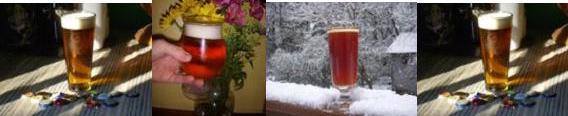
Feb 15, 2009

Bohunk + Extra Challenger Extra Pale


This was originally going to be a parti-gyle batch, but I decided running ten gallons off into a big tub, and then separating them. They will be the same gravity that way. The Bohunk batch will be six gallons (pre-boil), and the Extra Challenger Extra Pale will be four -- for a total of ten.

I wanted to make the second beer to use the Challenger hops I have wasting away in my freezer. Since I will be using all of the four ounces I still have, the Extra Challenger Extra Pale is going to be quite the hopster.

Target Gravity for both beers:
1.066
O.G = 1.064

The Malts:
20 lbs Pilsner
2.5 lbs Munich I
1.25 lbs Carahel
1.25 lbs Carapils

Bohunk Hops:
54.6 IBU
1 oz Sterling (7% AA) -- 90 minutes
1 oz Sterling (7% AA) -- 45 minutes
1 oz Sterling (7% AA)-- fifteen minutes (with a whirlfloc)
Bohunk Yeast:
Wyeast Urquell

Extra Challenger Extra Pale Hops:
57 IBU
(1/2 teaspoon gypsum in boil)
1 oz Challenger (7% AA) -- 60 minutes
1 oz Challenger (7% AA) -- 15 minutes
1 oz Challenger (7% AA) -- 5 minutes
1 oz Challenger (7% AA) -- Dry
Extra Challenger Extra Pale Yeast:
Wyeast Ringwood Ale

2.28.09 -- Gravity on Bohunk measuring 1.036, so I need to wait a little longer before starting diacetyl rest. This batch seems to be taking a little longer, and that could be due the age and generation of the yeast.
3.01.09 -- Gravity measured 1.028. Started dyacetyl rest.
3.10.09 -- Extra Pale racked into secondary. I was not paying as close attention as I should have, and it overflowed a little -- losing about 25% of the dry hop addition. Bohunk also racked into secondary and put in the cooler at 34 degrees.
4.6.09 -- Kegged Extra Pale, but did not check gravity. If it fermented all the way, it should be 1.019. which would make the ABV around 5.8%
4.15.09 -- I have had several glasses of the extra pale, yet I still do not know what to think of it. I do not think I can recommend using Challenger hops in this quantity. The bitterness is harsh, and the hop flavor, what may be called 'floral' tastes like rotten roses and earth in this amount. The beer is clean and dry, but the bitterness is just weird and challenging to say the least.
4.25.09 -- Dumped the remainder of the Extra Challenger out. Not a complete loss since I learned something valuable. Kegged the Oily Bohunk and hooked it up to the gas. I took a little sample and can already tell that this beer is going to be the shit.
5.1.09 -- Sampling Bohunk and it is as good as ever. I seem to have had to sample it three times today already.
5.13.09 -- Maybe not "as good as ever". The hop profile is not a spicy as it has been in the past. I think if I check my records, I used mosty Sterling for my last Bohunk with a little Saaz added at the end. That may be the difference. Also, the Urquell yeast I used for this batch was on its third or fourth generation, so that could have also resulted in mild quality issues. Still a solid beer, but I feel I could have done a little better here.

Jan 17, 2009

Yippie I.P.A.


Yippie I.P.A.
O.G. 1.071
72 IBU
6.9% ABV


This is the third incarnation of the recipe which was the first of my brews that I very proud of. Don't get me wrong, up to that point in 2003 I had made plenty of good beer, but this one was a little better. This recipe is a little different than the first two times, but how different, I do not know. I lost the index card on which the original recipe was written, but I know it had European hops rather than the American varieties in this one (Simcoe, Centennial, and Amarillo).


Notes:
1.18.09 -- (Brewday) I intentionally neglected to add all kinds of blogging notes while I was brewing. Promash is helping with that, especially since its settings provide the same deciphering as the equations I have been using. I pitched 2.25 gallons of yeast once the wort cooled to around 70 degrees. That is about all there is to report other than the fact that I am now using my new 50 watt aquarium heater which seems to be keeping up much better.
1.31.09 -- Measured gravity, and it measured 1.018. I added the dry hops and racked to secondary. Since there was extra beer in the primary, I also filled two 16 oz and two 12 oz bottles and added priming sugar. I added .5 teaspoon of cane sugar to the 12 oz bottles, and .75 to the 16 oz bottles.
2.20.09 -- Drinking the first of the bottle conditioned samples, and it is excellent. The hop profile is both citrusy (but not overly so (cat piss)) and earthy. It will be fun to compare these to the beer that is still in the secondary with the dry hop addition. Table sugar also primes beer very nicely.
3.10.09 -- Kegged.

4.22.09 -- The comparison between the dry hopped and the not dry hopped occured this past weekend, and in my opinion the beer without the late addition was a bit better. The beer with the 2 oz dry hops has a more aggresive (naturally) hop profile, and can be metallic tasting at times. I am pretty sure this is because of the Amarillo addition. Overall, the beer is quite good; the color is nice; the malt stands up to the hops, and it is most drinkable.

Dec 30, 2008

Rotkapchen Lager

Rotkapchen Lager
O.G. = 1.066
45 IBU
6.7% ABV
Current hop shortages have made recipe planning a little difficult. I was intending on brewing up a batch of Bohemian Pilsener today, but was unable to procure the appropriate hops to do so. My chest freezer is empty now, so that means I have to make some sort of lager to take advantage of the space. I have quite a bit of Mt. Hood hops, so this recipe was made to use those hops in a lager of some sort. The red, which will result from the dash of Carafa, was an afterthought, but makes for a good name.

Malt Bill:

10 lbs Pilsener Malt
2 lbs Munich
.5 lb Carahell
.5 lb Carapils
2 oz Carafa III

Hops:

1 oz US Northern Brewer (7.4% AA) 90 minutes
1 oz Mt. Hood (6% AA) 15 minutes
1 0z Mt. Hood (6% AA) 5 minuites
1 oz Mt. Hood (6% AA) Dry into secondary

Wyeast Urquell 2001 Yeast


I am using a two step mash with a 30 minute rest at 144 degrees and then an hour at 156. Sparging at 170 degrees should take about 55 minutes:


Brewday notes:
Infusion strike went well, and I ended up right at 144 after fifteen minutes / Mash was a little longer +5 minutes or so because I had to wait for sparge water to heat up / After sparging, I am coming up about a half gallon short. I am heating some more water up to 170 to sparge a little more. I need to learn to make more sparge water than I need -- either that or make my original infusion the same 1.3 quarts per gallon that I use with single step mashes /O.G. read at 1.066, up from the expected 1.062 -- could be because it boiled down to about five gallons instead of the 5.5 that are on my sheet.

1.4.09 -- checked gravity and it was down near 1.017. Started diacetyl rest.
1.10.09 -- Racked into secondary yesterday and added one ounce of Mt Hood. Turned the temperature down around 43, and then down to around 37 today. I will eventually get it as low as 34. I heard to turn the temp down slowly. I tasted my sample (which measured 1.015), and the hop flavor is very nice. Also, I had an enormous amount of trub in this one, so I was only able to collect about 4.5 gallons, if that.
2.20.09-- Transferred into the keg and turned on the gas.
3.2.09 -- This one is a hit. It is very crisp, and the Mt. Hood additions make for some nice flavor and aroma. The alcohol content is quite sneaky, though. This will not last long, but I am sure I will make this one again.
2.28.09 -- Thing is that this is my normal Pilsener recipe with just a small color addition and different hops. This is a good way to become familiar with the Mt. Hood hops.

Dec 15, 2008

Greymalkin's Juicy Dubbel Dubbel


O.G. = 1.098
81% Attenuated
10.5% ABV
27.85 IBU

Actually it should be a Quadrupel or a Belgian Dark Strong ale -- a "dubbel dubbel"; 2x2=4. It will be the second beer in a row with an ass name, but how can one resist referencing Shakespeare and Sir Mix-a-Lot at the same time? Yeah, me either. There was a day when I steered clear of any Belgian style beer. I think I had too many that were not well made, and were mainly high-gravity alcohol vehicles that gave me screaming ass headaches. That all changed the day I first tried St. Bernardus' ABT 12 and found myself lost in all that raisiny, pruny, sherry flavored dark fruit goodness. Now I love about anything from St. Bernardus (even though monks don't brew it).

The dark fruit flavors are what I am going for here, so I am choosing to go with the Candi Syrup rather than the nuggets as per the recommendations in this discussion thread. Here is the recipe I have come up with:
make it) as well as other Belgian breweries. See a Promash page with all the specifics here.

The Fermentables: weight x potentail x efficiency = extract

15 lbs Pilsner Malt
15 x 36 x .80 = 432
2 lbs Munich Malt
2 x 35 x .80 = 56
.5 lb Caramunich
.5 x 34 x .8 = 13.6
.5 lb Special B
.5 x 30 x .8 = 12
1.5 lb Dark Candi Syrup
1 x 30 x .8 = 24
.5 lb Cane sugar
1 x 46 x .8 = 36.8
Total extract = 574.4 / 6 gallons (preboil) = Target Gravity (1.o96)

The Hops:

1 oz of EKG (5.6% AA) @ 90 minutes will yield 19.32 IBUs

.5 oz Challenger (7% AA) @ 30 minutes will yield 8.53 IBUs
Total IBUs = 27.85


White Labs Trappist Yeast (WL500)

Mash Notes:
30 minutes in -- This is the first batch I am making using Promash. I added 5.85 gallons of strike water at close to 170 degrees using Promash tto figure strike temperature. It is a little too warm at 30 minutes in (160 instead of the inteded 154). I threw in a couple of ice cubes. I will check again in fifteen minutes or so. I figure the Promash can help me dial in my system a little better in regards to temperatures and what not. I seem to only be losing ten degrees, but usually it is fifteen. The tun did prime with boiling water for quite a bit longer than usual today.

12.31.08 -- Fermentation has been very active in a tub of water with an aquarium heater and a water pump to maintain temperatures. The 25 watt heater seems to be struggling a little. It is set at around 73, but only can maintain about 69. I have a 50 watt heater on the way.
1.2.09 -- White Labs Trappist yeast (WL 500) is a complete animal. It ripped through this 1.098 wort in seven days, leaving it at 1.019. I am sure adding a 2 liter starter had something to do with this. It is still bubbling a little, but that is likely to be the suspended CO2 escaping. I will check the gravity agian in a couple days to see if I should put it into a secondary to settle out. The 50 watt heater came today, and I may not even need it until later. The temps have been pretty consistently between 68 and 7, with one morning after a very cold night that was at 66.
1.09.09 -- Racked into secondary today.
1.18.09 -- Bottled

2.14.09 -- Opened one and it is barely carbonated. I looked at my notes for "22", and found that was the same issue a month after bottling that beer. I will wait another month before trying another. Tastewise, it is pretty close to what I wanted from what I can tell. The dark fruit flavors are certainly there, and there is a very pronounced dry phenolic character. We will see how some dense Beligian carbonation will affect the flavor. I just pray it comes. See you in a month.

2.23.09 -- I got wise and moved all the bottles out of the laundry room to the kitchen and living room where it is five to ten degrees warmer.

3.3.09 -- A "square root day" that only happens a few times every century. . . Had the first Greymalkin that was adequately carbonated, but still has a little way to go in that department. This is going to be a most wonderful beer in a couple more weeks. The dark fruit notes seem to be mostly cherry at this point. I need to see what I hand to say about Chimay since this is their yeast. That review is very remeniscent of this beer.

4.30.09 -- Regardless of what I had to say about "decent carbonation" in the above entry, it turned out not to be entirely true. The next couple of bottles I opened were flat as hell. Dejected, I resolved to wait until it began getting warmer in the house before I tried another. That happened this past weekend, and the results were very encouraging. Though I do not think this beer will ever have a fluffy full head like those that enjoyed an addition of fresh yeast at bottling, there is now ample head and effervescecnce that lifts the flavors onto the pallate. In short, it drinks like a beer rather than a wine now, and the dark fruit and malt falvors are so much more pronounced and enjoyable than before.

11.08.09 -- I had about 20 bottles (12 and 24 oz) of this beer left, and the carbonation never got much better than an initial fizzle. I decided today to open each one, sprinkle in a bit of dry yeast, and then recap them. We'll see. I cannot think I have done anything that would have made the carbonation less. Several of the bottles showed some immediate reaction to the yeast, so I took that as a good sign.

1.1.10 -- Drank one while brewing. The carbonation is greatly improved, but the head still fades pretty fast. At least now when it fades there is still head until the bottom of the glass.

6.15.10 --

Tasting Greymalkin's Juicy Dubbel-Dubbel

Appearance -- Carbonation has always been an issue, and that does not bode well for appearance, especially for style. No carbonation - no head. As I look back at the recipe, I wonder why I did not add any wheat in there. The color is pretty ruby/brown, and the beer is not very clear.

Smell -- A clean, plum scent is the most prevalent. The yeast character does not come through aromatically, but I think it should. I think this is also an issue attributed to the poor carbonation.

Taste -- This is a great tasting beer with the dark fruit flavors I wanted with a ginger-like spicyness from the yeast. The alcohol notes are muted well by the sweetness, and then come through in the finish in a fashion that is not at all harsh. After agitating the beer in the glass, and then drinking while it was still active, a cotton candy hint rides along with the finish.

Mouthfeel -- This beer is a great example of how much carbonation affects the other aspects of beer. The mouthfeel is flat and almost watery at times. This is improved by agitation in the glass, or by swishing in the mouth. The sheer volume of the malt bill compensates a bit for the otherwise absence of mouthfeel (unless artificially produced).

Overall -- In light of everything above, I still consider this one of my better works. The flavors are exactly what I wanted, and this beer, in my opinion, has only one flaw, albeit one that has such an overall effect on the drinking experience. I have not failed to re-yeast strong beers or beers that conditioned for a long time. That is something I can take away from this -- that, and beer. I look forward to tasting this one at the five-year mark, and perhaps past then. I think this beer will have more a port or sherry character if allowed to age for a while, especially since this is a beer that could handle it.

Nov 14, 2008

Padunk-a-Dunkel


Munich Dunkel
O.G. = 1.050
24 IBU
4.9% ABV

Grain Bill:

11 lbs Munich II
.5 lb Carapils

Hop Schedule:

1 oz Spalt (3.4% AA) -- 60 minutes
1 oz Saaz (3.5% AA) -- 30 minutes

Wyeast Urquell Yeast

Mashing:
I want to use a three step mash with a 20 minute rest at 144, a 60 minute rest at 156, and then a 10 minute mash out at 170. The method I am using can be found here in John Palmer's How to Brew , or in some of my other brewing posts.

Initial Infusion Equation:
Strike Water Temperature Tw = (.2/r)(T2 - T1) + T2

(.2 / .75) (144 - 85 ) + 144 = 159.7 degrees (two gallons)

Mash Infusion Equation:
Wa = (T2 - T1)(.2G + Wm)/(Tw - T2)

(156-144) (2.3+8.6) / (210-156) = amount of boiling water needed to get to 156

(12)(10.9)/54 = 2.4 quarts

(170-156) (2.3+18) / (210-170) = amount of boiling water needed to get to 170

(14) (20.3) /40 = 7.17 quarts / 1.8 quarts


Brewday Reflections: Perhaps starting out with .75 quarts per pound is not quite enough. The run-off got stuck, and thankfully I still had my trusty drilled out five gallon bucket along with my old bottling bucket. It was time to go old school. I just hope I reaped the gravity I was hoping for and the beer will be as clear as if it were run through the manifold in my normal tun. Thankfully I had plenty of homebrew to help me relax and not worry. One should also notice that I did not check the temperature all the way through like I may have in the past. I have found the formula above to be reliable, so I just trusted it.

11.23.08 -- Checked gravity, and it was down around 1.014, which 72% attenuated. I did not expect it to be this far. I am raising the temperature as much as I can in hopes I can get a few more points out of it, eating up diacetyl in the process.

11.28.08 -- Gravity was down to 1.012. Racked into secondary and turned temperature down to 34 degrees.

12.26.08 -- Racked into keg

1.3.09 -- First impressions: Very drinkable! This beer is light bodied and certainly smooth. The bread crust flavors of the Munich malt come through very nicely, though next time I may add a little crystal to make it a tad more complex. I am not complaining though. A great beer that probably wont last long. I will have to be sure to take a picture before it runs out.


Oct 21, 2008

Before the Blog 2006 - 2007

Superstition Coffee Porter -- October 1, 2006
Good Head Red -- October 20, 2006
Good Head Red II -- December 30, 2006
Yippie IPA II -- March 10, 2007
Rauchbier -- April 2007
Good Head Red III (first all-grain batch) -- August 2007
Schwartzbier -- Fall 2007
Stout -- October 2007
Good Head Red IV -- November 3, 2002 (R.I.P. -- November 24, 2007)

2009

Yippie I.P.A. -- January 18, 2009
Bohunk -- February 20, 2009

Extra Pale Ale -- February 20, 2009
Good Head Red 2009 -- March 10, 2009
Black Belgian Ale -- March 27, 2009
Bavarian Lager -- May 15, 2009
Belgian Strong Golden Ale -- May 15, 2009
Bavarian Amber Lager -- July 12, 2009
Belgian Blonde -- July 12, 2009
Belgian Ale (ardennes) -- July 28, 2009
Belgian Ale (Strong Ale) -- July 28, 2009
Precipitator -- October 12, 2009
Downpour Ale -- October 12, 2009
DSB ESB -- November 1, 2009
Yippy Three -- December 5, 2009

The Early Days 1995 - 2004

  1. Porter -- Summer 1995
  2. Dry-Hopped Ale -- Fall 1995
  3. Chocolate Stout -- Winter 1995
  4. Ginger Honey Experiment -- Early 1996
  5. Black Ale -- Early 1997
  6. Kolsch -- Early 2002
  7. Alt -- Spring 2002
  8. Dunkelweizen -- Summer 2002
  9. Das Riddlor -- July 2002
  10. Yippie IPA -- July 2003
  11. Orange Cru -- March 24, 2004
  12. Wheat -- Spring 2004

"37"


37 / 37 Jr. Big American Brown / Brown

37 Target Gravity = 1.095
37 O.G. = 1.090 (see below)
8.1% ABV

37 Jr. Target Gravity = at least 1.042 (before addition of Piloncillo)
37 Jr. O.G. = 1.056
4.7% ABV

It is that time of year again, the time to brew a double batch -- one being a strong beer to ferment and age in the cold weather, and then be bottled in the spring. The second runnings of this batch, "37 Jr." will be an expirement with wet hops. Both beers will be best classified as American Browns, though the Jr. may not be as hoppy, depending on how the wet hops (which are first year hops) work out.

I was fortunate enough to receive my Beer Advocate Magazine (II, IX) the same day I was to design this one since it had an article about Parti Gyle, which is the process of running off two beers from the same grain. The equasions in the article were most helpful in the predictions of gravities of both beers, something I thought was guesswork. The recipe below is for 10 gallons: four preboil gallons of "37", and six preboil gallons of "37 Jr.".

"37 Jr." is also an experiment with wet hops, which also happen to be a first year crop. If "jr." ends up being very sweet without much hop balance, we will know the rest of the wet hops in my freezer are shit. I do not think this is going to happen, though. The wet nugget hops smelled oily, earthy, and kinda funky.

Malt Bill (both beers):

16 lbs Marris Otter
3.6 lbs Biscuit Malt
3.6 lbs Crystal Malt (50L)
1.6 lbs Chocolate Malt

Hops (37):

1 oz Millenium (15% AA) 60 minutes
2 oz Mt Hood (6% AA) 15 minutes
1 oz Mt Hood (6% AA) End

Hops (37 Jr.):

1 oz Mt Hood (6% AA) 90 minutes
6.5 oz wet Nugget (?% AA) 15 minutes

Adjuncts (37 Jr.)

1 lb Piloncillo in boil

8 gallons strike water at 168 degrees hoping for a 154 degree mash. I used the equation from last time.
6.13 gallons sparge water

Brewday Notes:

32 Minutes into the mash: temp was around 150 with variations depending on where in the mash I stuck the thermometer. I stirred it a good one and closed the lid.
Later: I realize that opening the lid and checking temperatures every thirty minutes or so is just a source of unneeded stress.


Reflections on Brewday:

Mathematics were never my first love -- more a necessary evil. I imagine it was my faulty math that let to the first beer to measure at a gravity of 1.120. I suppose this was not a bad problem to have, but I think the yeast would not have been able to tolerate alcohol above 10%. It was a good thing I had about three quarts of purified water left over to add to the wort. After that addition, the gravity was down to 1.090. I suppose I will check my math to see if that is where I went wrong. Maybe I will even post it if I get bored enough. I may have also ran off a little more slowly than what would fit my 75% efficiency calculation. All in all I cannot complain. The pari-gyle equation allowed me to get a second beer with a gravity of 1.056, which is much better than the "jr." I got last time I did this.

Notes:
10.28.08 -- Issues, issues, issues. Issue #1: when using a blow-off tube, do not stick the free end into another empty carboy. The gas has to go somewhere. Fired off like a cannon and the counter presser squirted about 3/4 a gallon of wort all over the orange room. (Wives are generally supportive of the brewing arts until wort gets on the curtains). Issue #2: temps in the house are dipping below 60, and with the American Ale Yeast's (Wyeast 1272) optimum temperature being 60-72, I am experiencing very slow activity in the big beer.
11.7.08 -- Measured gravities: 37 = 1.030; Jr. = 1.022. I think 37 could be ready to rack into secondaries if I know it will continue to ferment since it has only attenuated 66% with an expected attenuation of 72 - 76%. I think I will leave Jr. in the primary until I am ready to keg, but that will be at least a few days more since it has only attenuated 61%.
11.14.08 -- Jr. reading at 1.020, which is still too high to keg. I am surprised it has not dropped more than this. 37 is reading at 1.034, which is high too. Both are around 63% attenuated, so I will wait and hope they both continue to drop.
11.21.08 --Falling temperatures coupled with a poor placement of the carboys (away from curtains) seem to have contributed to a stuck fermentation. After adding a starter made with dry American Ale yeast and placing it in a water bath heated with an aquarium heater and circulated with a water pump, big 37 is up and bubbling again. This is a relief since most of the resources are sunk into the bigger of the beers. Jr. does not seem to be doing much of anything, even with the addition of Champagne yeast. He will likely be kegged this weekend, if not today. I will keep my fingers crossed that the shaking I did to rouse the yeast does not result in oxidation issues. (later) Kegged Jr. Will update later.
11.23.08 -- 37 is reading at 1.031 right now, so it is still fermenting, albeit slowly. If it can get down to around 1.025, I will be very pleased since that will be nearly 72% attenuated. I tasted the sample and it already has a nice flavor, but still very sweet.
11.28.08 -- Down to 1.030. I am going to raise the temperature a little in hopes to have this done by next week so I can start on a new batch.
12.2.02 -- 1.029. Seems to be falling a point every five days. If I can get it down to 1.027, it will be 70% attenuated and 8.25% ABV. I will be happy with that. The hard thing will be the decision to bottle it or keg it.
12.17.08 -- "37 Jr." has been kegged for a couple weeks now, and the oxidized flavor was certainly present. It was not overwhelming, but I knew it was there. Today I said screw it, and dumped 2 oz of Challenger hop pellets into the keg along with the four or so ounces of cherrywood chips I have been soaking in 100 proof Southern Comfort. The keg will stay at room temperature for a while, and then we will see. "37" is reading at 1.028 right now, so it is getting kegged. The ABV will be close to 8.1%, which is an estimation since I added extra yeast / starters which could have changed the gravity.
"37"
1.3.09 -- Some good, some bad. "37" is a very respectable beer. It is a deep dark brown (black) with caramel nutty aromas. The taste has notes of oak and vanilla, though neither were used in the recipe. Certainly a sipper at a little more than 8% ABV. When I bottle my Quad, I will also bottle a couple of these to store away for a while. "37 Jr." is just fucked. I never got to know how the dry hopping / chip addition worked since the chips seemed to have clogged the keg. I cannot get anything out of it. I did smell the tell-tale oxidized scent, so I think I will dump it. My first keg dump ever.


1.06.09 -- Jr. got dumped out.
3.2.09 -- Bottled two "37"s from the keg and hid them somewhere I may not find them again for a couple of years.
3.10.09 -- Put the rest of the 37 in bottles.

2010

Jahrfunfzehn Lager -- January 1, 2010
Turkey Vulture Blonde -- January 1, 2010
Double Toasted Oatmeal Chocolate Too Many Adjective American Stout -- February 26, 2010
Bavarian Amber Lager -- April 2, 2010
Belgian Dubbel -- April 2, 2010
Spiced Special Ale -- April 2, 2010
Jahrfunfzehn Helles -- June 12, 2010
GOld Scratch -- June 12 2010
Don Juan Saison -- July 17, 2010
Funky Don Juan -- July 17, 2010
Oily Bohunk -- September 4, 2010
Belgian Amber Ale -- September 4, 2010
Sour Brown Ale -- October 23, 2010
Mordecai Brown -- October 23, 2010

Padunk-a-Dunkel -- December 22,2010
Brown Trout -- December 22, 2010