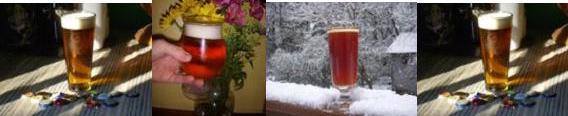
Sep 1, 2010

Oily Bohunk / False Prophet Ale


Bohunk O.G. -- 1.060 -- 1.015 -- 5.9% ABV -- 43 IBU


False Prophet O.G. -- 1.075 -- 1.015 -- 7.86% ABV

Target Gravities:
Amber - 1.066
Bohunk - 1.051
70% efficiency / 13 gallons of preboil wort

Malt Bill:
22# Pilsener Malt
2# Munich I
1# Carapils

Hops:
90 minute boil
3oz Saaz (5.5%) 60 Minutes
30z Saaz 15 Minutes+ Wirlfloc
2oz Saaz 0 Minutes

To be steeped in wort made from above to make Amber:
1.5 Caramunich
1.5 Aromatic
1 Piloncillo

Yeast:
Bohunk: Weihenstephaner Dry
Amber: washed 1388 (Duvel) Starter

9.37 gallons strike water (1.5 q per pound)
3.13 gallons absorbed
Instead of adding the gallon of boiling water, I am going to pull a 1/3 decoction to bring the mash up to mash-out temperature. I will boil this decoction for about ten minutes.
6.75 gallons sparge

9.4.10 -- Brewday reflections: things went very well and smoothly. Efficiency went up ( overshot target gravity by .09 points). I am still very unpredictable with my efficiency with the batch sparging. Next time I may figure for 73% instead of the 70% I figured for this time. The decoction also went very well; we will see if it affects flavor. This may have also contributed to the jump in efficiency. Both beers are cooling now (lager in the chest freezer, and the ale in the new cooler box I constructed). I will pitch yeasts tomorrow morning once the wort has had a chance to cool down a little. I think it was in the 85 range when they were done chilling, and they both spent about 40 minutes in an ice bath.
9.5.10 -- Pitched yeast into both beers.

False Prophet Notes:
9.19.10 -- false prophet reads 1.015 - 80% attenuated.


9.29.10 - kegged false prophet.


12.24.10 -- The false prophet has been somewhat of the stepchild of the fridge, first behind Don Juan Saison, and now Mordecai Brown. That is not to suggest this is not a fine beer. It may not be my best work, but it is a very respectable Belgian style amber. The Duvel yeast is very expressive, which is the dominant flavor here. I believe I will, when steeping grain for a second beer, I will increase the ammounts since the steeping is not provinding as much character as I originally wanted. This beer could benefit from a deeper caramel flavor from the crystal malt -- Duvel yeast is a lot to compete with, which is what makes it idea for SGA. All that being said, it is still a good beer, and I have lifted more than one glass on a few occasions.


Oily Bohunk Notes:


9.25.10- 1.017 (72%). Diacetyl rest begun (removed from freezer).


9.26.10 - bohunk racked beginning to drop temp over next few days.


12.22.10 -- moved to keg in chest freezer to make room for Padunk-a-Dunkel. I still need to get a final gravity on the bohunk.


1.11.11 -- Bohunk is hooked up, and should be ready to go today. I may have to shake it a little to get it a little more carbed. It is the second snow day in a row, so we are going to need some tasty Pilsener. Wooo. Final gravity around 1.015.

Jul 16, 2010

Don Juan Sasion / The Funky Don Juan

Don Juan Saison - 1.060 - 1.009 - 6.7% ABV

Funky Don Juan - 1.060 - 1.005 -7.2% ABV
SECOND BEST IN SHOW - PEACH STATE BREW-OFF 2012

35 IBU


Target Gravity - 1.066
64% efficiency -- I have no idea why it is so low. I seemed to have more wort than I thought I would.


Ten gallons of saison -- half of which to be funked with the dregs of two bottles of Orval. This is my first attempt using yeast strains outside the world of sacchromyces.

View the recipe page here, and ignore the fact that I did not enter many of the more technical information.

After much research I have decided to add the dregs along with the Belgian Saison strain that will be the base yeast. I had considered adding it in a secondary, but have decided after much reading and question asking to add it at the beginning since the Saison yeast is likely to finish with a very low final gravity, leaving little for the Brett in the dregs to much on.

Each beer is getting a 3qt starter.

Brewday Notes / Reflections:
7.17.10 -- Things went rather well except for low efficiency, which I think has something to do with the amount of wort I collected. I figured for 13 gallons instead of the usual 12 since my last batch seemed short a gallon at the end; this one had at least a gallon extra. Maybe I should go back to twelve. There is also a chance I made an error measuring the water. I probably lost a few points due to the fact that my boil was not as hard as normal. I thought I was wasting gas keeping it turned up so much, but now think I should turn it up a little more. Regardless, a 1.060 saison is going to work just fine.
7.18.10 -- about ten hours after pitching, both beers show vigorous activity. Ambient temperature is around 76, and beers are in water baths that I am going to add ice to now to keep the temp as low as I can using this strategy.
7.21.10 -- fermentation has slowed to a crawl, so I moved the carboys from downstairs where they have been between 72 and 76 degrees to upstairs where it is already above 80 before 9:00 a.m.


Don Juan Notes:


7.27.10 -- Transferred into secondary so I could wash the yeast. Gravity is at 1.027 which makes it slower than the funky version. The tastes of the samples are much different, with this one being much cleaner without the yeasty notes that I am sure will develop more as the beer finishes. I will leave this one alone for a while, and then check the gravity again.


8.8.10 -- gravity reads 1.023 -- going much slower than last time I brewed saison, and it is much hotter. We have been having 100+ heat indexes for the last week and a half at least. The yeast character is beginning to show through much more, but the finish is really sweet. I am going to wait much longer than a week and a half to test this one again.


8.28.10 -- gravity reads 1.017, which is 72% attenuated. Still has a while to go, and we are at week six. I may have to pitch more yeast to finish this off before it is too late. Sample tastes good, but still a little sweet.


9.14.10 -- Gravity 1.014 - 77% attenuated and still moving. pitched about 8oz starter made with washed yeast at time of last reading agitated regularly after repitch. Still hoping for attenuation in the 80s.


10.25.10 -- Kegged. Final Gravity = 1.009 - 85% attenuated. Sample is nice and dry, but I am not able to taste the yeast characteristics to the extent that I expected. Perhaps carbonation will help. This is going to be a good one nonetheless.


2.18.11 -- Don Juan Saison gets a collective score of 36 at the Big Beers Belgians and Barleywines Festival in Vail, Colorado. It was even moved to the second round, the "mini B.O.S." round. Click to enlarge thumbnails:


.

.

Funky Don Juan Notes:


7.23.10 -- 87 degrees ( ambient temp is 80 at time of taking sample). Gravity = 1.024 -- adjusted to 1.027. The sample tastes very yeasty and I am surprised that I can already taste a little dry wooly funk. I thought this needed more time to even be noticeable. I will check in a few days before taking it back downstairs at around 1.020 so it can cool down a bit and give the brett more sugars to eat.


7.25.10 -- Gravity down to 1.024. I will move it back downstairs tomorrow or the next day. It shed three points in two days.


8.8.10 --Gravity Reads 1.008 -- the brett must have really done some work since I brought it down stairs, though the temp has been in the 80s in the laundry room where it is. The funk is really shining through nicely with a sweaty type taste that goes well with the hops. It may be time to secondary this one soon.


8.15.10 -racked into secondary. Gravity= 1.006 at 80 degrees. Adjusted to 1.008, the same as a week ago. Sample seems like it is drying out a bit. bottled about 36 oz with .75tsp table sugar.


9.23.10 -- Drinking the big bottle I primed early: the beer is very dry and without any high alcohols with a lovely funk that I know will increase, which is good since it is a little fainter than i expect it to be. This is a very enjoyable beer, and I cannot wait to enjoy the rest once the time comes.


11.15.10 -- Gravity reads 1.005. Bottling at 4 volumes.


12.19.10 -- Tried one of these and the taste was very buttery and the mouthfeel was rather slick. Discussion on Homebrewtalk . . .

3.26.12 -- Won second best in show at Peach State Brew-Off 2012:


Jun 11, 2010

GOld Scratch / Jahrfunfzehn Helles

GOld Scratch -- O.G. = 1.087 -- 1.006 -- 10.6% ABV Jahrfunfzehn Helles -- O.G. = 1.056 -- 1.015 -- 5.4% ABV

Target Gravities: Lager -- 1.057 Strong Golden -- 1.077


.


Malt Bill 25 lbs Pilsner Malt Other Fermentables: 2.5 lb Cane Sugar


.


Hops: 2oz Styrian Goldings (5.2) -- 60 min 1.5oz Saaz (5.5) -- 30 min


8 gallons strike water (1.44 q/pound).


3 gallons absorbed add 1 gallon boiling water Collect six gallons Six gallons sparge water for a total of 12


Pale lager Strong golden Dough--356 421 - mashing too hot. I've added ice cubes and now I am trying to relax. 507 - running off first wort. Mash was much closer to 159 than the 149 I was shooting for 623 - boil begins (few interruptions) 803 - chilling almost done. Wort seems short. May figure for thirteen gallons next time. Strong golden og - 69degrees / 1.086 Lager og - 79 degrees / 1.054


.


strong Golden Ale Notes:


6.19.10 -- Fermentation went well for the first six days. It started cool ( around 62), then up to around 75. i moved the bucket into the hall yesterday so it could warm up some (into the low 80s).


.


7.7.10 -- Gravity reads 1.004 at 78 degrees (1.006). Cold conditioning begun.


.


7.14.10 -- reyeasted, primed, and bottled at 4 volumes of carbon Dioxide


.


3.12.11 -- Scored a 35 at the Peach State Brew Off in Atlanta, winning the silver medal in its flight: scoresheet


.


Extra Pale Lager Notes: 6.29.10 -- Diacetyl rest begun. Much later than normal. Closer to twenty days than the normal ten. 7.6.10 -- It has taken a while for the chest freezer to warm up to 70, but it has been that high for a good three or four days. I beers are getting racked tomorrow. 7.7.10 -- Lagering begun. Gravity at 1.013 at 78 degrees (1.015).


Mar 29, 2010

Bavarian Amber Lager / Dubbel / Special Cherry Belgian Ale

amber 1.047 - 1.010 -- 4.8%ABV
dubbel 1.059 - 1.007 -- 6.8%ABV
special 1.062 -- 1.006 -- 7.3%ABV

This brewday is going to be an ambitious one. First, I am using my newly modified system with a pump; I will be batch sparging for the first time in a while, and will be spiking my wort post mash to make three different beers: five gallons of Bavarian Amber Lager, five gallons of Belgian Dubbel, and three gallons of Belgian Spiced Specialty Ale. On top of that, I am trying to use up all the hops I bought in October figuring the alpha acid loss after almost six months.

Malt Bill:

15 lbs Pilsener Malt
15 lbs Munich Malt

Hops
2oz Cascade 60 min
3oz Tettnang 40 min
1oz Tettnang 20 min
if these hops were fresh the IBUs would be around 34, but with age, it should be closer to 20.

Dubbel:
Started with 2 gallons of water in which I steeped:
12 oz Special B
1 lb Honey Malt
Then I boiled:
2 lb Table Sugar
1.5 lb Dark Candi Sugar Syrup
I then added wort to make five gallons

Spiced Special Ale:
I started with one gallon of water in which I boiled:
2 lbs Piloncillo
1 Star Anise
1/2 tsp ground clove
I then added wort to make four gallons

Amber *Whitelabs 833 slurry / dubbel *Wyeast 3787 3 quart starter / special *T58 dry Belgian yeast

1012 dough
1027 145 degrees
1113 vorlauf
1202 sparge almost done
1226 Belgianizing wort chilling
136 chilling commences I thnk with the new pump recirculating the wort, it will go quickly
205 110 degrees
226 80 degrees
246 chilling ends
Lager 44 of at 82 degrees
Dubbel 58 at 70 degrees
317 dubbel pitch
Special 61 at 69 degrees
341 done start cleaning


Corrected gravities:
amber 1.047
dubbel 1.059
spiced 1.062

Calculating efficiency at 60%. I knew it would take a hit batch sparging, but this much? Shit.

Reflections on Brewday:
Efficiency sucked, but after some reading and discussion, I think I have a short list of remedies for next time. 1) Mash out. I have become accustomed to not doing this when fly sparging. I am going to add a gallon of boiling water to mash at end to raise the temp. 2) If after the mash out, I still have a large amount of sparge water to add, I will cut it in half. www.dennybrew.com was recommended to me, so I will read more about his technique before next brew day. I believe he heats his sparge water up to 185, which is something I heard was a no-no, in the past, but I have to realize that I am changing my technique, and that the things I held as gospel in the past may have to be unlearned.

Aside from the efficiency issue, everything went great. The brewday was certainly quicker, and the pump worked like a charm. I recirculated the wort for the last fifteen minutes of the boil, and throughout the chilling procees (which I think sped up this step).

4.5.10 -- Fermentation on the two Belgians seems to be going very well. We have had unusually warm weather the past few days, and ambient temperatures have peaked at 80 in the hall where the buckets are. At night and in the morning, they are closer to 68. I pitched the yeast at 70, and it started pretty quickly (3 quart starter), so I am not overly concerned about the dreaded ethyl acetate, that is not to say I am not concerned. The amber also started bubbling today.
4.11.10 --
  1. Amber gravity reads 1.012 diacetyl rest begun. The sample was dry and already having a little crispness. This is going to be a very good session lager.
  2. Special Spiced gravity reads 1.010, but it does not taste very spiced. I am soaking one more star anise in vodka to add at bottling. I had added more clove to the vodka, but dumped it when the mixture smelled like NyQuill to me.
  3. Dubbel gravity reads 1.018, which is only about 70% attenuated. Hopefully turning the heat up to 78 will help with that. I have also seen that Wyeast 3787 is very slow and tenacious.
4.15.10 -- Amber gravity down to 1.010. Lagering begun. Bought 2 quarts of organic tart cherry juice for three gallons of the Special wort. Remainder will go on oak in a gallon jug -- four beers from same wort.
4.18.10 -- Racked the special into the three gallon carboy with two quarts of organic tart cherry juice. Gravity measured 1.009 before the addition, and 1.013 after.
4.19.10 -- Dubbel gravity reads 1.007. 81% attenuated.
4.27.10 -- Bottled Honey Dub-Bell at three volumes. Final gravity was 1.007. Tasted from Belgian Barrel, and the oak flavor was there, but I think I will taste again in a couple days.
5.30.10 -- Tasted the Belgian Barrel last night, and tasted the oak notes I wanted. Bottled today. The 12oz bottles got .75 teaspoon table sugar; the 22oz got 1.25.
6.9.10 -- Bottled special at four volumes. Gravity read 1.006.
6.11.10 -- Kegged amber. Gravity was still 1.010
6.18.10 -- Amber lager makes a great black and tan with Too Many Adjective Stout

6.22.10
Tasting Bavarian Amber Lager
Appearance: Clear amber with many bubbles rising to the head, which is thick and fluffy. This beer is a real looker. See:
Smell: Mild hoppy and yeasty aromas. Very clean.
Taste: This beer is very balanced, without leaving a malt or hop character to take charge. The finish highlights the easy-going hop profile well. The overall impression is balanced and clean.
Mouthfeel: Very light and crisp. Carbonation is probably a little high for the experts, but for me, it is where I like it.
Overall: Though it was not the intention to make a beer this light and refreshing, I am glad I did. In fact the lager I am fermenting right now will be just a tad bigger than this one. I should make beers like this more, and they would lend themselves well to making a partigyle with this being the smaller of the two beers. Overall, this is much better than my last lager, and encourages me more to use the Ayinger strain of yeast (though I think the Weihanstephaner is a little better).
7.15.10 -- Honey Dub-Bell Pictures:

7.20.10 -- Tasting Honey Dub-Bell:
Appearance: opaque brown with just a faint head after pouring - hopefully this will improve, but i am unsure if it will being this long after bottling. smell: very clean smelling with just hints of the Belgian yeast character. A toasty malt aroma is in there too.
Taste: very nice, starting with faint dark fruit notes and malty accents, and finishing dry with Belgian yeast spiciness and a bit of hop flavor ( from the saaz addition, I figure). as the beer warms the fruit characteristic becomes a little bit bigger, but it is still not dominant. This beer is quite dry it does not have much of the caramel character most dubbels have. I suppose this is because of the lack of the special b I intended to use. The honey note that is there in its place is very nice, and comes in more when the beer warms.
Mouthfeel: this beer is light bodied and easy to drink. It is more refreshing than many dubbels, knowing that refreshment is often not the point with the style.
Overall: I think this came out very well, but it may be unfair to call it a dubbel. I think the name Honey Dub-Bell is very appropriate because it addresses the deviations as well as the base style. This example is very encouraging to use the method of making a small amount of candi, sugar, or other wort on brew day to add to a base beer. The displacement caused by this extra wort opening the door for yet a third ( or fourth) beer is also very encouraging. I am sure I will do it again.
7.23.10 -- Tasting Belgian Barrel:

Appearance: hazy dark gold in color with a thin head. I need to do more to get better head retention. I used to be in the habit of always using a little carapils, but not as much lately. I need to get back into that habit. Overall. Good looking beer, but the head bothers me some.

Smell:
bready with a mild yeast scent. The oak is not very aromatic at first whiff. The peppery nature of t-58 is mildly apparent.

Taste:
the oak flavor is very weak at first sip, but this is a very nice and peppery belgian blonde as it is right now. I certainly would use this yeast again, and can now see why so many say it would be good for a wit. The pilsner and Munich malts in this one work very well together, and it seems as though i can taste them both individually. this is strange in that I do not perceive the flavors as individually in the lager. I would expect he clean nature of he lager to allow each of the malts to come through, but the belgian yeast seems to do a better job in this respect. I am going to get a little glass of lager now to compare. The oak nature comes through more when the beer is allows to warm just a little - out of the 40 degree fridge for about ten minutes. ( tasting lager - I do get the same sensation( pilsener taste up front followed by the Munich breadyness), but not to the extent. With the Belgian barrel)

Mouthfeel: though the head is a little weak the effervescence of this beer is not. I cannot remember to what volume i primed these, but i know it did involve guesswork.

Overall: overall, I am very pleased with all the beers this somewhat experimental session has produced, and though i said it earlier, I would do it again. Though the oak nature in this bee is not very pronounced, it does add a nice complexity to the finish that does not domineer at all. This is a solid Belgian ale, and i would consider making more than once gallon of next time.

Mar 9, 2010

DAS Land of Organisms

DAS Land of Organisms
(Na nanna na)
 
DAS Land of Organisms is born from some extra Landlord clone and dregs from several bottles of sour/wild/brett beers.
 

t-58 Dry Yeast + Culture from one bottle Paradox Tart Noire (fermenting at ambient temp (68 - 78)) 

Transferred to glass carboy about three weeks later along with stir plate culture (malt and apple juice) of dregs from:
 

Feb 22, 2010

Double Toasted Oatmeal Chocolate Too Many Adjective Stout


Target Gravity -- 1.083
Original Gravity = 1.084
55 IBU
Oak Aged 1028 1.084 - 1.015
Chocolate Draft 1968 1.084 - 1.025

Malt Bill

27 lbs Marris Otter
1.5 110 - 150L Crysta
1.5 135 - 165L Crystal
3 Roasted Barley
1 Chocolate Malt
2.25 lbs Toasted Quick Oats

Hop Schedule -- 55 IBUs

6oz Willamette (4.8) -- 60
2oz Willamette (4.8) -- 30


10 gallons strike water (all jugged drinking water)
8 gallons sparge water (Crawford)

Yeasts:
Half will be fermented with 1028 slurry
Half will be fermented with 1968 slurry

326 - tun closed and mash begins after stirring for a long time.
345. - mashing around 150 more stirring. This is close to the grain limit for this tun.
455 - runoff begins
617 - weigh a normal sip of beer: 1.5oz
725 - back from short shutdown for oliver's bedtime.
756 - boil begins.
856. - boiling ends / chilling begins.
1013 - gravity reads 1.084
1111 - all ice baths over, cleanup finished.


Reflections: second time in a row the water machine screwed me. Things went pretty smoothly otherwise.

3.19.10 -- Earlier this week I was treated to one of the worst stenches I have ever experienced. While the 1968 half of this beer was fermenting, it was getting a little vigorous, so I popped the top a little off the fermenter to allow the gas to escape more quickly. A good bit of foamy wort and yeast oozed out into the water in which the bucket is sitting to maintain temperature. After a couple days of this, I thought "well enough", snapped the lid back on, and left town for a week. It did not occur to me that the spilled wort would be kept at a balmy 70 degrees by the aquarium heater in the water, which is a great niche for something really stinky. I promptly racked the beer into a secondary and cleaned up the mess. I hope none of the bacteria found its way inside the beer -- possible, but probably not. The gravity read about 1.027, which is a bit under-attenuated, so I hope it moves a little bit more in the secondary.

In other news, the rules for the next club contest have been made public, and it calls for a single addition of something not extract after fermentation is complete. The chocolate extract I had would have not fit the bill, so I put it in the 1968 carboy today, and will probably add oak chips to the 1028 so I can enter it in the contest.

3.27.10 -- racked the 1028 version into the secondary. Gravity was 1.015, which is much lower than the other one was. I hope the 1968 has been dropping more in the past week so it won't be terribly sweet. The sample from the hydrometer tube tasted great, and I having mild doubts about messing with this one any more by adding the oak. We'll see.
4.7.10 -- Tasting after being oaked for one week (2.5 oz medium toast French chips): The oak flavor is there, but in more of a woody way than a vanilla way. It is hard for me to tell what is exactly going on when the beer is warm and flat.
4.8.10 -- Racked beer off the chips (8 days), then bottled
4.14.10 -- measured the gravity if the draft chocolate 1968 version. It was 1.026, just at 70% attenuated. I wonder why it was so low. The sample tasted very good, and the chocolate flavor was at a good level too.

Jan 2, 2010

Crawford Vulture Blonde Ale / Jahrfunfzehn Lager

Crawford Vulture Blonde
O.G. 1.060
F.G. 1.011

6.4% ABV


Jahrfunfzehn Lagerbier
O.G. 1.060
F.G. 1.011
6.4% ABV


At dusk on brewday, I was visited by more than thirty turkey vultures who roosted in the tree just above my shed. They were close enough to hear their wings flapping when they were startled. This is not a very odd occurrence here in Crawford -- especially in the winter.
O.G. = 1.060


Malts:

19 lbs pils
5 lbs Munich 1
1.5 lbs carapils


This has almost 6% carapils which is a little much. We'll see if it makes the beer too chewy. I don't think it will be a big issue since most recommend ip to 5%. I think I have 5.8%


1.060 at 75% eff

Hops:

3oz tettnanger 3.2% - 60
2oz tettnanger 3.2%- 30
1oz cascade 5.4% - 15

28 ibu
Brewday, January 1, 2010

7 gal strike
9.2 gal sparge

430 - dough in
445 - near 150
557 - run off begins
805 - boil begins
909 - boil ends
1013 - gravity reads 1.060
1111 - done

Reflections on brewday:

Things went pretty smoothly aside from the water machine sterling my money and having to go to Bell's to get seven gallons of water. Temperatures were in the twenties, especially later in the evening, this made the chilling go quickly. I also could not find my flashlight, so that was a little bit of a challenge.

Jahrfunfzehn Notes:
1.11.10 -- Check the gravity and it was already down to around 1.015. I started a diacetyl rest in hopes of getting a couple more points out of it. The gravity was a little lower than I expected it to be -- perhaps WL833 works a little faster than the lager yeasts I have used in the past. The sample tasted wonderful.
1.14.10 -- Racked into a secondary and measured the gravity again. It did not seem to move. (1.015) I am going to wait another day before beginning to drop the temperature in hopes of shedding a point or two.
3.29.10 -- Kegged and placed in the the fridge. Final gravity about 1.011, so I see it shed more than a point or two. ABV = 6.4%

Crawford Vulture Blonde Notes:

1.23.10 -- Primed with around 4.88oz table sugar. This is the first time I have primed a whole batch with sucrose. Final Gravity = 1.011.

Dec 5, 2009

Yippy Three


Malts
23 lbs Maris Otter
2 lbs 60L Crystal
1 lb Carapils
1lb 150L Crystal

Hops
3oz Cascade 60
2oz Cascade 45
1oz Centennial 30
1oz Centennial 20
1oz Simcoe 10 (12%AA)
2oz Cascade 5
2oz Cascade (Dry) (In each Secondary)

Brewday Notes:
6.75 strike
9.7 sparge

641 - begin runoff
705 - trying to pace it right. Last time I was too slow. O think I am doing it well this time.
811-or shortly afterwards, runoff ends
924- 20 minute addition becomes .5oz centennial and 1oz cascade
942- correctly zeroed scale. Figure for 1pz centennial plus a half oz of cascade
950-chilling begins. It may not take long since it is 32 degrees out here.
1127-all done

I shorted the 1028 batch by almost a half gallon. Take into consideration that the 1968 batch is bigger.

Sent from my iPod

Notes:

12.26.09 -- Transferred both to secondaries and dry hopped with 2oz Cascade. I also collected two pints of the 1968 that would not have fit. Primed each with 3/4 teaspoon table sugar. Forgot to measure final gravity of 1028, but the 1968 was 1.019, which was similar to the ESB. I think I may have also forgotten to record the original gravity. Regardless, I am positive it was somewhere between 1.060 and 1.066.
12.28.09 -- I was concerned about the amount of headspace in the 1028 carboy, so I went ahead and bottled it. I noticed a little activity in the airlock, so I checked the gravity first: 1.017.
3.6.10 -- The 1028 is certainly different than the 1968 version that sat on the dry hops for so long (a little more than two months). The aroma is obviously not as present, and the mineral nature of 1028 is more perceptable in this beer than in the ESB. Both are fine beers, with the 1968 edging out the 1028. So far there was not a big difference between the ESBs, and a small difference in the Yippys, and we will see about the stout.

Oct 28, 2009

DSB ESB

Target Gravity -- 1.060
Original Gravity -- 1.066
52 IBU


Malt Bill:
22# Maris Otter
2# 60l Crystal
1# CaraAroma
.5# Carapils
Hop Schedule:
60 -- 4oz Willamette (4.8%AA)
30 -- 2oz Willamette (4.8%AA)
15 -- 2oz Willamette (4.8%AA)

Brewday Notes:
Mashing thicker than normal 1.3 quarts per pound to produce more dextrines and body. Mash and sparge water was approximately 1:3 reverse osmosis water:Crawford, thinking it may be closer to the harder English water.

8:24 -- Dough-in
8:41 -- 152 degrees
9:36 -- Run-off begins
11:29 -- Run-off ends
11:57 -- Boil Begins
1:00 -- Boil Ends
1:07 -- Chilling Begins
2:10 -- Chilling Done
2:15 -- Beer #1 (1968) Ice Bath Begins
2:47 -- Beer #2 (1028) Ice Bath Begins
3:15 -- END

Mashing thicker went well, and I will likely abandon the 1.3 quart per pound as my norm. Mash / Lauter tun overflowed during sparge, so I will just keep my eye on it next time I use that much sparge water. I also had to bottle a little bit of wort so to check the gravity later because I broke my hydrometer today.

Looking at the times above, I think I will shoot for an 1.5 hour run-off rather than the 2 hour. I have been trying deliberately to lengthen my run-off since I had a bad efficiency day not long ago when I ran off very quickly. This beer came in .006 points higher than I planned for, so a more normal run-off should help that. I am impressed that chilling only took an hour, and that I had the presence of mind (relative sobriety) to let each beer sit in the ice bath for a half hour.

DSB ESB Notes

11.03.09 -- Read gravity from bottled wort
(1.066)

1968:
11.22.09 -- Racked into secondary Final Gravity = 1.019 (6.1% ABV)
12.19.09 -- Kegged.


1028:
11.22.09 -- Bottled. Final gravity = 1.017 (6.4% ABV)
2.27.10 -- Tasting the 1028 version:
  • Appearance: This beer has been cloudy since I first tapped the keg however long ago. It is now beginning to clear a bit, and is a very nice copper hue when held to the light. The head is ample and stays around for a while.
  • Smell: Not a very aromatic beer. The biggest smell I notice is a bit of earthiness from the Willamette. I expected to smell more of the yeast character, but I do not.
  • Taste: Hop character seems to be the lead with a good malty sweetness to back it up some. The hop flavors linger more than the malt, and the English yeast helps tie it together, adding a tiny bit of fruitiness the American strains do not have.
  • Mouthfeel: This beer has a nice medium body that is perhaps accented by a higher level of carbonation than what is recommended for this style.
  • Overall: I think this came out quite well, and cannot think of many things I would change. If pressed, I would say I would get back into the habit of using clarifying agents since this one took so long to clear. I might experiment more with biscuit malt in a beer like this as well. It will be fun to see how the 1028 version compares.
3.29.10 -- 1028 version scores a 32 in the Peach State Brew Off (VG). I expected better.
4.5.10 -- Here is the score sheet from said competition. Maybe I should not have been so down on my 32

Oct 5, 2009

Precipitator / Downpour Ale


Precipitator (6.2% ABV)
Downpour Ale (
6.8% ABV)
Target Gravity -- 1.064 (nailed it)
Estimated IBUs -- 24.9


Grain Bill:
24 lbs Munich II -- 85.7%
1.5 lbs Carapils -- 5.4%
1 lb CaraAroma --3.5 %
1lb CaraMunich --3.5%
.5 lb Chocolate Malt -- 1.8%


Hop Schedule
2 oz Tetnanger 3.2%AA -- 60 min
2 0z Tetnanger 3.2%AA -- 45 min
1 0z Tetnanger 3.2%AA -- 15 min

Bock -- Bavarian Lager Yeast
Ale Bock -- American Ale Yeast

9 gallons strike water (half reverse osmosis / half Crawford
7.5 gallons sparge water (3.5 of which was rain water)


Brewday Notes / Reflections:

9:45 -- Mash-in at 165 / 10:03 143 in middle, 154 on side stir stir stir / 10:18 around 154 had targeted around 151 with thermal mass set to .1 / 11:11 begin run-off / 1:25 boil starts / 2:09 switched propane tanks and added about 20 minutes to the boil since the last few were not very vigorous.

An extremely rainy day , but with a tarp, the shed roof made a nice tent for everything important. I had to take my rain coat on an off several times for other activities outside the shed. I was also graced by Meat Snacks' presence for some of the run-off, the whole boil, and chilling.

I made sure this time to run-off a little slower because last time my efficiency sucked. I also stirred more than I had in the past, which was a good idea since at dough-in, I was pulling up dry pockets of grain for several minutes. Efficiency ended up at 75%, and I nailed my target gravity.

Changed propane tanks halfway through the boil; I need to keep track of how long these are lasting so not to run out again. Now I have two tanks. The only other negative thing aside from the propane misshap that happened was that I may not have chilled the beer enough before pitching yeast. The ale was no warmer than 75, as was the lager. Each spent at least fifteen minutes in an ice bath, so they were probably a good ten degrees cooler than that. I think the level of intoxication influenced patience at the end.

Downpour Ale Notes:

10.21.09 -- Gravity measuring 1.013, which should be close to terminal gravity. I am going to let it sit for at least another week.
10.30.09 -- Kegged. Final Gravity was 1.012. (6.8% ABV)
11.07.09 -- Drinking about my third Downpour from my new .5L Spaten Oktoberfest glass, and I am quite pleased. The cara malts shine through nicely with a light dark caramel sweetness that is accented nicely by the bready toastyness of the Munich malt. The fresh Tettnager hops balance all this sweetness out with a very clean (I know this is oxymoronic) earthy bitterness. This is one of the better beers of late, and a good reminder why the cooler months are the best for brewing.
12.02.09 -- I bottled six of these this week as entries into our homebrew club's contest. What follows is a review on a day nearly as rainy as the day this beer was brewed. I heard a story recently on public radio saying that this year is Georgia'a wettest, as far as climatologists could reckon, in over five hundred years -- I digress:
Downpour Ale Review (during actual downpour ... see map below)
Appearance: Downpour ale is very dark brown, and may be percieved as black from a short distance. When held to the light, very little makes it though, but one can see that it is indeed a mahogany brown. Head is thick, and retains well.
Smell: The first thing one notices is the absence of a yeasty scent, which is expected when using a yeast as neutral as S-05. A faint bready smell and a just as noticeable caramel character are in there too. Hops also provide a little to the overall aroma, but Downpour Ale is for the most part subdued in the smell category.
Taste: This beer is subtle, but with a mild complexity that could be missed by one drinking this as more of a session beer (which I have done, and do not ascribe any fault to that manner of consumption). Bready nature of the Munich malt provides a strong backbone for the dark caramel / coffee sweetness from the dark crystal as well as for the earthy sharpness of the Tettnanger hops. An alcohol note arrives late, but it is not at all overbearing, even though the ABV approaches 7%.
Mouthfeel: This is a medium-bodied beer on par with porters and some lighter bodied stouts.
Overall: I am excited about this beer, and like its chances in the contest. I may be surprised, depending on the number of entries, if this does not make it to the second round. This beer is flavorful, and the drinkability does not suffer as it does in other beers with these kinds of characteristics.


Precipitator Notes:

10.30.09 -- Racked to secondary. Final Gravity was 1.o19. (6.2% ABV)