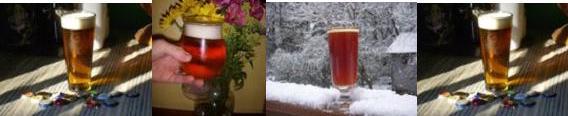
Apr 29, 2008

For Real ESB

ds


Target Gravity = 1.055
Target IBU = 44
Original Gravity = 1.055
IBU = 42.65


Wannabe Special Bitter was a very nice beer, but it certainly was not a real bitter since I used Cry Havoc yeast, which was originally collected by Charlie Papazian from a keg of Budweiser, which makes it a lager yeast. Supposedly, Budweiser uses a different strain of yeast today. The yeast was advertised as a lager / ale hybrid, but I think they meant that it was more resistant to high temperatures than other lager yeasts.

This time I am going to use London ale yeast, and I have also tweaked the recipe a little to try to get a more complex malt taste as well as achieving the color I want without adding Carafa at the end. I am hoping the Crystal, Chocolate, and Roast malts will get me what I want.

The Malt:
8 lbs Pearl Pale Malt (66%)
2.66 lbs Crystal 60L (20%)
1.63 lbs Munich II (13%)
2.5 oz Roasted Malt (1%)

The Hops:
.5oz Challenger (7% AA) -- First Wort Runnings
.5oz Challenger (7% AA) -- 60 minutes
1 oz East Kent Goldings (5.5% AA) -- 45 Minutes
.5oz Challenger (7% AA) -- 15 minutes
.5oz East Kent Goldings (5.5% AA) -- End

The Mash:
12.45 pounds of grain x 1.3 quarts = 4.05 gallons of strike water. Strike water will be 165 degrees hoping for a 155 degree mash. I seem to be losing around ten degrees when I treat the tun with boiling water and then cover it up with blankets -- at least for the first while before I have to make adjustments later.

20 Minutes In -- The temp was not much more than 145, but I do not think the mash is really that cool. I am going to wait ten more minutes and see if the thermometer catches up a little.

30 Minutes In -- The temp was around 146, which makes little sense to me. It is warmer than the last few times I brewed, I primed the tun with boiling water, and I have blankets over it. The last couple of times, I was only losing around ten degrees. I am nuking some water to throw in there now.

37 Minutes In -- Added one pint of boiling water. I will wait five minutes to check temp.

45 Minutes In -- The temperature is still the same; I don't get it. I am nuking more water.


50 Minutes In -- Added another pint of boiling water, and noticed that the valve on the empty hot liquor tank I have connected to the tun was open. This may be the reason for the heat loss.

57 Minutes In -- Temperature has climbed to around 150. Meanwhile, I am nuking more water. This is getting ridiculous.

64 Minutes In -- The temperature is STILL FUCKING LOW after adding a quart and a half of extra boiling water. Nuking more water.

70 Minutes In -- Temperature was up near 154. I added about a half pint more of boiling water (I really do not know why). I also added thirty minutes to the clock since the temp has not been up to 150 yet. I am not going to fuck around with this any more until it is time to run off.


Sparging:

12.45 pounds of grain x .125 absorption = 1.56 gallons. 4 gallons - 1.56 = 2.44. 6 gallons - 2.44 = 3.56 gallons of 170 degree sparge water needed.

Notes:

5.11.08
-- Transferred to the secondary. Fermentation stayed around 73 degrees all week. London III yeast is a lot more active than I thought it would be. Maybe I just got a really fresh batch.

5.23.08 -- It is getting hot outside, so I put the carboy in the fridge. It will stay there until one of the two kegs in there (IPA and Schwartz) is empty.

6.15.08 -- I kegged this beer and put it back into the fridge. The final gravity is 1.019. ABV will be around 4.7%.

6.23.08 -- First Impressions: The yeast really does it to this beer. The difference between this and the Wannabe is large. In short, this is a great fuckin beer, and since I have so many EKG and Challenger hops, I will make more soon.

7.25.08 -- This is a most solid ESB. The color is on, and it is very drinkable. I am not sure of changes I would make to this beer, but I may still compare it to examples like Samuel Smith's Old Brewery Pale Ale or Bombardier. Like this says above, this beer will be made again, but I am concerned about the temperature I have been losing lately. I think next time I am going to wrap the tun with a 0 degree rated sleeping bag.

8.15.08 -- A session beer par exelance . . . Nice and clean now; could drink them all night. Might be my next brew. . . oh, and the sleeping bag turned out to be a good idea.

8.28.08 -- This blew tonight. I got about a 4oz farewell.

Apr 2, 2008

Schwarzbier


Target Gravity = 1.050 (6 gallons x 50 = 300)
Original Gravity = 1.051

50% Munich II x 300 = 150
42% Pilsner Malt x 300 = 126
4% Carahel x 300 = 12
4% Carafa x 300 = 12

(Potential Gravity / 75% efficiency)
150 / (36 / .75) = 5.55 Lbs Munich II
126 / (36 / .75) = 4.66 Lbs Pilsner
12 / (36 / .75) = .44 lbs Carahel
12 / (35 / .75) = .46 lbs Carafa

*Additional .5 lb carafa in sparge*

Hops:
1 oz Tettnanger (4% AA) 90 minutes = 16.16 IBU
1 oz Tettnanger (4% AA) 30 minutes = 11.41 IBU
1 0z Tettnanger (4% AA) End = 2.85 IBU

Total IBU = 30.42

The Mash:

11.11 Pounds of grain x 1.3 quarts = 3.61 gallons strike water.
Strike Water will be 160 degrees aiming for a 150 degree mash. Like the last time I brewed, I am priming the tun with boiling water, and will be covering it with blankets through the mash.

Calculating Absorption and the needed amount of sparge water:
I have been debating on the necessity of this step, thinking I may just fill the hot liquor tank with sparge water, and then use all I need to collect six gallons. I am resisting the
temptation to do this now, but think there must be some reason for doing this. So, here it goes:

11.11 pounds of grain (x .125) = 1.38 gallons of water absorbed.
3.61 gallons strike water - 1.38 = 2.25 gallons
6 - 2.25 gallons = 3.75 gallons of sparge water needed.

40 minutes in: Temperature reads 148 degrees. I will check again in about 20 minutes to see if it drops.
60 minutes in: Temperature was down near 140 degrees. I added 2 cups boiling water, and started another two cups. I will check again in about ten minutes.
About five minutes later: Temperature was back up to 150.

4.20.08 -- Transferred to secondary.
4.27.08 -- Since it is getting warmer outside, I kegged this beer and stuck it in the back of the fridge. I am not force carbonating it yet; just pressurized it up to around 20 lbs and put it out of the way so it can stay cold. I will hook it up to more gas when one of the other kegs are empty.
5.10.08 -- I should have checked the keg sooner. When I checked, it had no pressure left, so I hope it had not been that way for a while. I imagine the pressure inside and outside the keg were equal, so I should not worry about oxygen getting in. Anyhow, I plugged it up to the gas, and it should be ready to serve in less than a week.
6.15.08 -- This schwartz has prooved to be a very solid beer. It is very black, but light with a smokey aroma and taste. This is a nice black beer for the summer time, and this example shows exactly what the original brewers of this style had in mind (if I do say so myself). Picture soon.
6.23.08 -- There is the picture. Doncha just love my cock?

Mar 11, 2008

Noc-a-homa I.P.A.

Target O.G. = 1.060 O.G. = 1.060!
Target IBU = 50 IBU = 52.6

This is the first beer I am making with the help of Designing Great Beers by Ray Daniels. Never before have I set a target original gravi
ty and IBU. We will see how close I get. I am also making this with on East Kent Goldings for hops since I bought a pound of them on ebay. I expect this beer to be gold / amber; a step or two darker than the Gold Glove Leapday Ale. I am still reading the chapter on color.

Malt Bill:
85% (11.5 lbs) Marris Otter Two Row (x 36 Potential Gravity) = 414
11% (1.5 lbs) Crystal Malt 10L or 20L (x 34 Potential Gravity) = 51
4% (8 oz) CaraPils (x 34 Potential Gravity) = 17


I have been averaging efficiency at 72% ( GHR, Bitter, and Golden). I am going to shoot for 75%.

Target total potential gravity = 482 of which 360 (6 gallons x 60) is 74.68%.


The Hops:
Bittering Hops = 1 oz East Kent Goldings (5.6% AA) -- 90 minutes
Flavoring = 1 oz East Kent Goldings (5.6% AA) -- 30 minutes
Aroma = 1 0z East Kent Goldings (5.6% AA) -- 15 minutes
Aroma = 1 0z East Kent Goldings (5.6% AA) -- end
---
Dry Hop = 1 oz East Kent Goldings (5.6% AA) -- dry hop in secondary

The above additions equal an estimated IBU of 52.6, which is higher than the 50 I targeted, but the hops I am using are a little old, so this may even out.


Mashing:

13.5 pounds of grain x 1.3 quarts = 4.39 gallons. I am going to heat it to 165 hoping for a mash around 155. I have boiling water in the tun now hoping to minimize heat loss.

By my calculations, I will need about 3.3 gallons of sparge water to run off 6 gallons. This will be 170 degrees.

Fifteen minutes in: Temperature is at 156 degrees, so heating the tun up and covering it with blankets seemed to help. I am going to let this do its thing and not fuck with it to read temps for a while.

One Hour, Fifteen minutes in: I checked the temp and read it as 150.

One Hour, Twenty-two minutes in: I added about one pint of boiling water and shut the lid.

Running Off -- Wort looks paler than I expected.

Boiling -- Was boiling . . . 90 minutes.

As you might have seen above, I hit my target gravity on the nose -- 1.060. I did not expect that to happen. What can I say?

Notes:

3.23.08 -- Transfered to secondary and dry hopped with 1 oz EKG (5.5% AA).

4.20.08 -- Kegged. Final Gravity = 1.021. ABV = 5.1%. Sample in the hydrometer tube did not taste overly hoppy. We'll see.

5.11.08 -- I am very pleased with the Noc-a-homa. I intended this to be a milder IPA, not something more typical of an American Pale Ale. The English hops and the target IBU makes this beer mild, yet hoppy. It is, however a bit overcarbonated since I jacked the gas up and then forgot.

6.0.08 -- Noc-a-homa has cleared up very nicely, though it still is a bit overcarbonated. I have found this to happen in beers I have dry-hopped. With the abundance of EKG in my freezer, I will certainly make this again, though I may increase the IBUs just a tad. I do not want to make this taste like an APA (which would be hard without any C hops), I just would like to make the EKG a little more pronounced.


Mar 9, 2008

"22" / "22" Jr.


"22" was born from my desire to brew something strong. When this is done in an all-grain way, it would be silly to throw away perfectly good grains that have perfectly good sugar in them, so that is how "22 Jr." came along. He was a nice German lager while he lasted. Now it is "22"'s turn to shine (or at least get bottled) after mellowing patiently for nearly three months.

"22"'s malt bill was simple:

10 lbs Munich II
10 lbs Vienna

I considered calling this one a Salzberg beer since that is directly between Munich and Vienna, but I opted with "22" since this was the 22nd beer I ever brewed.

I mashed the 20 lbs of grain in 6.5 gallons of 170 degree strike water. The mash maintained a nice 155 degree temp.

I then ran off 4 gallons of wort for "22", then ran off the remaining water plus 170 degree sparge water until my 6 gallon pot was full.

I hopped "22" this way:

.75 oz Pearle (1st wort runnings)
.75 oz Pearle (60 Minutes)
1oz Hallertaur (15 minutes) (added Irish Moss)
1oz Hallertaur (End)

I hopped "22" Jr. this way:

.5 oz Pearle (first wort runnings)
.5 oz Pearle (90 minutes)
1 oz Hallertaur (15 minutes)
1 oz Hallertaur (End)

Gravities:

"22":
O.G. = 1.094 (yeah!)
F.G. = 1.022
9.4% Alcohol by Volume

1 week in Primary
3 months in Secondary


"22" Jr.:
O.G. = 1.040
F.G. = 1.012
3.6% Alcohol by Volume

1 week in primary
7 weeks in secondary
It took about two weeks to drink all the Jr. It was my first draft beer.

3.9.08 -- Bottled "22" after it spent nearly three months in the secondary. I could already tell it is going to be strong. I can't wait to see what it is like once it conditions. I am going to try to keep my hands off this one for a while, though I am sure I will have my first try in a couple of weeks.


3.23.08 -- Tasting notes from first bottle of "22": Hardy Carbonated: what a waste. It does have a lovely color, and a sweet malty taste that covers the alcohol content nicely. I think I will go shake the rest of these a little to make sure they carbonate.

4.28.08 -- Tried another tonight -- much, much better. This beer is going to age very well. It already has a very deep malt character, and the hops balance it nicely. The alcohol warmth comes through nicely. This will encourage me to brew a strong ass beer every winter.
3.1.09 -- It was snowing, so that made me want some strong lager.

Feb 29, 2008

Gold Glove Leapday Ale


The goal here is to make something easy to drink, similar to Oily Bohunk Bohemian Pilsner, but an ale that can be made easily in the summertime. I kept the same grain bill as the Bohunk, but changed the yeast and hops. I also opted for the Munich I instead of II to make it a little lighter. Beertools.com says this recipe is closest to a Maibock, but I am not so sure since I am using American hops. I am calling this American Golden Ale since it did not fit the parameters for a Blonde Ale or Kolsch since the predicted O.G. is too high.

Grain Bill:

9 lbs Pilsner Malt
2 lbs Munich I
.5 lb Carapils
.5 lb Carahel

Hop Schedule:

.5 oz Northern Brewer (7.4% AAU) -- First Wort Runnings
.5 oz Northern Brewer (7.4% AAU) -- 90 Minutes
1 oz Mount Hood (3.7% AAU) -- 15 minutes (along with one wirlfloc tablet)
1 oz Mount Hood (3.7% AAU) -- End

American Ale Yeast

The Mash:
I am going to try a multi-rest mash on this one to try to add a little extra clarity (or efficiency?). I am going to make this attempt with the formula found here. It is two pages, so you can see the formula I am using on the second page.

Initial Infusion Equation:
Strike Water Temperature Tw = (.2/r)(T2 - T1) + T2

Mash Infusion Equation:
Wa = (T2 - T1)(.2G + Wm)/(Tw - T2)

where:
r = The ratio of water to grain in quarts per pound.
Wa = The amount of boiling water added (in quarts).
Wm = The total amount of water in the mash (in quarts).
T1 = The initial temperature (¡F) of the mash.
T2 = The target temperature (¡F) of the mash.
Tw = The actual temperature (¡F) of the infusion water.
G = The amount of grain in the mash (in pounds).

Here is my figuring with .75 quarts of water per pound in the protein rest, and the original temperature of the grains and tun is 62.
Strike Water Temperature TW = (.2/.75)(122-62)+122
(.267)(60)+122= 138 degrees (9 quarts)

Ammount of Boiling Water to Add WA =
(155-122) (.2G + 9) / (210 - 155)
(33) (11.4) / 55
376.2 / 55 = 6.84 quarts

9 quarts + 6.84 quarts = 15.84 quarts.
If I had been mashing my old way of adding 1.3 quarts per pound in a single step mash, this would have equaled 15.6 quarts, so I am on par.


15 minutes in: Temp is right around 125 degrees -- a little high, but I am happy to be this close.

45 minutes in: I added the boiling water fifteen minutes ago, and now the temp is right at 150 degrees. It should be 155, but I am going to wait another ten to fifteen minutes before I add more water.

63 minutes in: I added 1.5 cups of boiling water to try to get the temp up to 155 from 150.

I just found this tool that I will use to get more accurate hydrometer readings. I always start racking at 75 degrees, so this will be easy.

O.G. = 1.054 (and I did not make the correction which would have been 1.062 since I took the reading well after I was racking at 75 degrees.)
F.G. = 1.020
ABV = 4.45%


Notes:

3.2.08 -- Yesterday I saw a couple of clumps that looked like meatballs rising to the top, and by the end of the day there was quite a collection, and fermentation had begun.

3.9.08 -- Racked into secondary. I skipped this step with the last couple, and I am unsure if I will continue this practice. Good Head Red V was way too cloudy. I don't want that to be the case with this pretty gold ale.

3.11.08 -- Calculating Efficiency:
9 lbs Pilsner Malt X 36 = 324
2 lbs Munich I x 34 = 68
.5 lb Carapils x 33 = 16.5
.5 lb Carahel X 34 = 17
Total Potential Extract = 324 + 68 + 16.5 + 17 = 425.5

Original Gravity 6 gallons X 54 (1.054 O.G.) = 324

425.5 / 324 =
74% Efficiency

3.23.08 -- Kegged and measured final gravity.

4.02.08 -- This beer is nice and mellow -- just begging for a hot day. It could very well go by the name of Cream Ale. It is not too hoppy, and smells a little like Budweiser (but not in a bad way). Still could use time time to clear up, so no picture yet. I am wondering if I remembered to add a whirlfloc tablet. I know I forgot to on this one or the IPA.

5.02.08 -- Picture Day! I have to take a picture of this quick because I know it will be gone soon. This beer is so very clear, it makes me wonder if that is a result of the protein rest. It is such a nice beer for the spring: very comparable to Terrapin Golden Ale, but sweeter with a bit more body and yeast-fruitiness.
This guy gets no gold glove:

Feb 15, 2008

Complete Homebrew List

  1. The Early Days 1995-2004
  2. Before the Blog 2006 -2007
  3. 2007 - 2008
  4. 2009
  5. 2o10
  6. 2011
  7. 2012
  8. Post 2012


Porter -- Summer 1995Dry-Hopped Ale -- Fall 1995Chocolate Stout -- Winter 1995Ginger Honey Experiment -- Early 1996Black Ale -- Early 1997Kolsch -- Early 2002Alt -- Spring 2002Dunkelweizen -- Summer 2002Das Riddlor -- July 2002Yippie IPA -- July 2003Orange Cru -- March 24, 2004Wheat -- Spring 2004Superstition Coffee Porter -- October 1, 2006Good Head Red -- October 20, 2006Good Head Red II -- December 30, 2006Yippie IPA II -- March 10, 2007Rauchbier -- April 2007Good Head Red III (first all-grain batch) -- August 2007Schwartzbier -- Fall 2007Stout -- October 2007Good Head Red IV -- November 3, 2002 (R.I.P. -- November 24, 2007)"22" -- November 2007"22" Junior -- November 2007 (first draft beer)Oily Bohunk Bohemian Pilsner -- January 18, 2008Orange Cru II -- February 1, 2008 (extract)Good Head Red V -- February 1, 2008Wannabe Special Bitter -- February 15, 2008Gold Glove Leapday Ale -- February 29, 2008Noc-a-homa I.P.A. -- March 15, 2008Schwarzbier -- April 5, 2008For Real ESB -- May 3, 2008Noc-homa I.P.A. II -- July 13, 2008Peasant Beer -- July 13, 2008Rustic Farmhouse Ale -- August 9, 2008El Jeffe Weizen -- August 29, 2008Slightly Olier Bohunk -- October 3, 2008"37" -- October 25, 2008"37 Jr." -- October 25, 2008Padunk-a-Dunkel -- November 14, 2008Greymalkin's Juicy Dubbel Dubbel -- December 26, 2008Rotkapchen Lager -- December 30, 2008Yippie I.P.A. -- January 18, 2009Bohunk -- February 20, 2009
Extra Pale Ale -- February 20, 2009Good Head Red 2009 -- March 10, 2009Black Belgian Ale -- March 27, 2009
Bavarian Lager -- May 15, 2009
Belgian Strong Golden Ale -- May 15, 2009
Bavarian Amber Lager -- July 12, 2009
Belgian Blonde -- July 12, 2009
Belgian Ale (ardennes) -- July 28, 2009
Belgian Ale (Strong Ale) -- July 28, 2009
Precipitator -- October 12, 2009
Downpour Ale -- October 12, 2009
DSB ESB -- November 1, 2009
Yippy Three -- December 5, 2009
Jahrfunfzehn Lager -- January 1, 2010
Turkey Vulture Blonde -- January 1, 2010
Double Toasted Oatmeal Chocolate Too Many Adjective American Stout -- February 26, 2010
Bavarian Amber Lager -- April 2, 2010
Belgian Dubbel -- April 2, 2010
Spiced Special Ale -- April 2, 2010

Wannabe Special Bitter


O.G = 1.050 IBU = 36.8

This is an attempt to create something close to something between Samuel Smith's Old Brewery Pale Ale
and Wells Bombardier. Many recipes recommend adding flaked maize and not making cultural references to the Spice Girls, but that is where I am different. I am calling this Special Bitter since regular bitter, or "mild", the 3% or so session beer designed to allow you to chill at the pub for a couple of hours is not very available, nor is that very desirable for me right now. I am aiming for somewhere around 5.5%. Let's hope I remember to take a hydrometer reading.

Wannabe Special Bitter
The Grain:

8 lbs Marris Otter (66.6%)
2 lbs British Crystal Malt (50-60L) (16.7%)
2 oz Carafa III (16.7%)


The Hops:

.5 oz Challenger (8% AAU) First Wort Runnings
.5 oz Challenger (8% AAU) -60 minutes
.5 oz Kent Goldings (5% AAU) -15 minutes (along with one clearfloc tab)
.5 oz Kent Goldings (5% AAU) End

Cry Havoc Yeast

The Mash:

10 lbs grain x 1.3 quarts water = 3.25 gallons strike water (165 degrees hoping for a 155 degree mash)
Absorption = 10 lbs x .125 = 1.25 gallons / 3.25 - 1.25 = 2 gallons
Add four gallons sparge water to equal a six gallon boil.

Fifteen minutes in: Temperature low (around 140something). I do not know why this is happening since I treated the tun with hot water before mashing since it is in the winter. I added about a quart of 200 degree water, and now I am waiting a few minutes . . .
Twenty-five minutes in: The temperature was around 160, so I threw in one ice cube, and that dropped it down to around 155.
Seventy minutes in: The temp was back down to 150, which is acceptable, but not exactly what I want. I
added another 8oz or so of hot ass water. I am beginning to be concerned that this mash is going to be way thin because of all the extra water I have added. From the quick research I just did, it looks like I may want to look into learning how to calculate brewing efficiency and putting a thick blanket over the tun next time.

O.G. = 1.050
F.G. = 1.016
4.4% Alcohol by Volume


Oh, and then there is this, which has become obligatory. . .


Notes:

2.17.08 -- Fermentation has begun. The temperature seems to be hanging in there at 65 or so.

2.28.08 -- Using Ray Daniels' Designing Great Beers as a guide, I calculated the brewing efficiency of this batch with the following formula. The factors are pounds, simplified gravity readings (1.050 becomes 50, etc.), and the potential gravity of different grains according to a chart in his book:
8lbs Marris Otter x 38 = 304
2lbs British Crystal x 34 = 68
.125 lbs carafa III x 30 = 3.75
304+68+3.75 = 375.75 (Potential Gravity of Grains)

Original Gravity: 1.050 x 6 Gallons:
50 x 6 = 300 (Actual Gravity of Wort)

300 /375.75= .80
80% Efficiency
Can this be true?

2.29.08 -- Kegged. Seems to taste right -- the hops are not overpowering at all, yet they are there. The color could be just a pinch darker. It is red / brown, but not the ruby color I was shooting for.

3.14.08 -- First impression: this is a beer made for drinking. It has less body than Wells Bombardier and Samuel Smith's Pale Ale, and that is probably because of the choice in yeasts. Kegging it and letting it condition in the fridge for so long seems to have been a good idea.

4.06.08 -- Picture day!! I am also realizing that this beer is exactly what it was named as it was being brewed. With the lager yeast, it really is a Wannabe Special Bitter.

Feb 1, 2008

O.C. II


The first O.C. (Orange Cru) was all fucked up, but when I found a four-year-old bottle of it it tasted like Grand Marnier. This four-year-old bottle was the ass (what I bottle after the bottling tube gets all clogged with yeast and hops). I figured I could do a nice little extract brew while I mash and cook an all grain recipe. This version is not at all meant to resemble a bright white Belgian Grand Cru. I am going for something thicker and spicer -- like Grand Marnier.


O.C. II :

Extract and Other Sweets:
Approximately 2.75 lbs -- Extra Light DME (It has to be used -- getting old.)
3 lbs -- Wheat DME
22oz -- wildflower honey from Lakemont, GA
1.5 -- Ground Coriander
.5 oz -- Dried Grated Orange Peel (grind it at least three days previous. dry in a paper bag -- about three oranges' worth)


Hops:
1 0z Target start
.5 oz Willamete end (which I forgot until after I pitched the yeast -- put it in then (?))

Belgian Wit Yeast

There really is not much to say here since I am not mashing, and I do not have to worry about temperatures, etc. I could mention that I fucked up and added the boiling hops that were meant for Good Head Red V.

O.G. = 1.050
F.G. = 1.015
ABV = 4.59%
Potential Alcohol = 6.8%
Final Alcohol = 2%
ABV = 4.8%

. . . I am
going to make sure I have my head on straight next time I attempt to brew two beers at once. I switched the hops, forgot the aroma hops for this beer, and also forgot the 12oz of malto dextrin I bought to make this beer thicker.

Tunes I think I could chill to in the bath with a glass of O.C. and a fat
Jay:

Big Poppa -- The Notorious B.I.G.
Florida Hurricane -- Saint Louis Jimmy
So Cruel -- U2
Dirty Mothe -- Roosevelt Sykes

Or you can get all of the above in a .zip file:

O.C. II Playlist .zip

Notes:

2.3.08 -- Bubbling away. From what I understand, Belgian Wit yeast has no problems in this area. My last batch of O.C. was way carbonated, and this may be the reason. I think I am going to have to move the Good Head Red to another place in the house because it may be too cold where I have these carboys. O.C. doesn't seem to mind though.

2.8.08 -- Still bubbling slowly. I am in no hurry with this one. It may speed up if I put it in the warmer room, but it seems to be doing fine where it is. It has a stack of krausen like a foamy urinal cake still after five days.

2.15.2008 -- Racked into secondary, which may be unnecessary at this point, but the last batch of beer I made with Belgian Wit yeast was way over carbonated. That is why I am taking this extra step. I will bottle this when I feel like bottling beer. I do not think there will be much harm in letting this one chill out longer as long as it is cold by the back door.

2.17.08 -- Now I understand why the last version of this beer was so over carbonated -- Belgian Wit Yeast is a wild animal! The beer I racked into the secondary is bubbling again. There would have been a major mess if I had not heard it hissing and squirting through the airlock. Seventeen days later, and it is still going. Patience with this one . . .

2.24.08 -- Bottled today. I just hope I do not have the carbonation issues I had with this kind of beer last time. I think I am in the clear since I waited longer for all the sugar to ferment out; I do not think this was the case last time.

3.9.08 -- I am so pleasantly surprised at the outcome of this beer. It is obvious to me that I bottled my last batch of O.C. waaaaaay too early, and that is why they turned out to be beer bombs. This one is so complex with the orange, coriander, honey, wheat, and yeast all showing up for their part in the show. The color is beautiful and the head is great. I can't wait to see what this will be like in a couple more months.

7.25.08 -- I wish I would have saved all of these this long. This beer improves so much with age. The flavors are so much smoother and unified at this point.

Good Head Red V


This will be the fifth batch of the beer I decided would be the house brew after I tasted the first. This one is a wee bit different than the others with a substitution of Biscuit Malt and Carapils for the Munich II I used in the past. This will certainly be different than the Good Head Red IV that escaped from a broken carboy and spilled all over the floor. You will see the differences compound further with each time I fuck up. Maybe brewing two beers, making two blog posts, and two playlists is a little ambitious.

GOOD HEAD RED V:

The Grain:
10 lbs Maris Otter
1 lb 60L Crystal Malt
1 lb Biscuit Malt
.5 lb Carapils
2 oz Roasted Barley


The Hops:
These are also a little different from other versions with the world wide hop shortage going on. The Kent Goldings I used in the past are substituted with Target.

.75 oz Willamete -- first wort runnings
1.75 oz Willamete -- -60 minutes (after foam breaks)
1 0z Willamete -- -15 minutes (along with a Whirlfloc Tablet)
1 oz Willamete -- end ( which I forgot until the wort was chilling. I added it then.)

(Notice that these are all Willamete. That was not the intention. Maybe this is why you should not brew two beers at once. You may become confused and put the wrong hops in the wrong beer. O.C. II got the Target hops, which may be too strong. I think it will all come out since the acid count would be similar if you added them all up.)

I am heating (right now) four gallons of strike water to 170 in hopes for a 155 degree mash. I am expecting the 12.5 pounds of grain to absorb 1.56 gallons (12.5 x .125 = 1.56). That means I will have to add 3.56 gallons of sparge water to get a 6 gallon boil (4 - 1.56 = 2.44) (6 - 2.44 = 3.56)

15 minutes into mash -- 156 degrees
45 minutes into mash -- below 140! -- I added about 2.5 cups of 200 degree water.
10 minutes later -- still low. I added three more cups of 200 degree water.
Last 30 minutes of mash -- I just checked it and it was up to 150. I added a few more cups of boiling water to get it up a little more. I am not going to fuck with it any more. The worst that can happen at this point is the beer coming out a little dry (let's hope).

O.G. = 1.048
F.G. = 1.020
3.66% by gravity reading (1.048 - 1.020 = .028 .028 x 131 = 3.66%)

Potential Alcohol = 7% / Final Alcohol Reading = 2.5%
4.5% by this reading, which is clearly different than the other. Maybe this is Alcohol by Weight? Fuck it. I know this beer is between 3.66% and 4.5%. The true test will be the "how do you feel after 2? 3? 4? test.

Estimated IBU = 58

Good Head Red V Playlist
The Criteria for this playlist are the songs that made me air guitar or bounce a little while brewing up this batch of beer (all via Mediafire):

Shake Your Money Maker -- John Little John
Good Bye Babylon -- The Black Keys
Some Dispute Over T-Shirt Sales -- Butthole Surfers
Juicy -- Better Than Ezra
Sonic Reducer -- Pearl Jam with Joey Ramone

Or you can dig all these in this zip file:

Good Head Red V Playlist .zip

Notes:

2.3.08 -- No real activity yet. The yeast seem to have reproduced themselves well. This is evident by the large layer of yeast at the bottom of the carboy. I think it is too cold where I have the carboy now (60s). I will move it today.

2.6.08 -- Fermenting well. It may be getting close to being done. I would like to keg this batch along with Oily Bohunk this weekend so I can have two beers on tap.

2.8.08 -- Kegged and put in the fridge. Should be ready to drink in 4-6 days.


2.15.2008 -- This beer drinks nice already, which is great considering I brewed it up two weeks ago. It will get better with a little more time, so I should slow down a little. I am wondering how much different this beer will be from the Wannabe Special Bitter I am making now. It may not be much.

2.28.08 -- If I am calculating efficiency the right way, this mash was 64%, which kinda sucks. This beer seems a little weak, but it is still good.

2.29.08 -- Picture day. This beer is not going to win any beauty contests, but it is still good with a nice bready aroma, and just a little hoppyness -- all with pretty good body. It makes me wonder if this would have been any different if I had used the Target hops as I had originally intended. The red does not show very well, and it is a bit cloudy (no secondary on this one).

3.11.08 -- Calculating Efficiency (while drinking GHR):

10 lbs Marris Otter x 37 = 370
1 lb Crystal Malt x 34 = 34
1 lb Biscuit Malt x 34 = 34
.5 Carapils x 33 = 16.5
.125 oz Roasted Barley x 27 = 3.37

Potential Extract = 370 + 34 + 34 + 16.5 + 3.37 = 457.87

6 gallons X 48 (1.048 O.G.) = 288

288 / 457.87 = 63% Efficiency -- this does not surprise me when I look at the notes of how the temperature dropped so much. I need to remember to wrap the tun in blankets or something -- this, or add boiling water to it before I start.

3.13.08 -- This beer started looking more an more clear, so I thought it was about to blow. Well, I was right. I drank the last glass today as I sat in the yard with my shoes off.